Letter to my three inch oak tree
You came to me in late fall. I didn’t see the gray squirrel who buried you in the mulch patch, you tiny little acorn. Just a couple of inches into the dirt. And then you went to sleep. Was the winter as hard for you as it was for me? But you didn’t mind all that snow and ice on top of you, did you? Actually it was good for you. As it all melted, it only provided you the moisture you needed when you woke up. And the squirrel who buried you didn’t remember where to look for you over the winter. I know you were hoping for that forgetfulness on its part. So you were lucky also!
When I pulled you out of the ground I expected a weed. Instead I got a big surprise. And then you started me on this learning path about your life, from the acorn to the giants of your kind. I am grateful for that! Next time I’ll be more careful of those tiny little leaves just sticking up three inches above the ground. If you are in a bad spot I’ll transplant you to a better one. I’ll watch over you and protect you, though I know I’ll never get to see you as a young tree! Note: Click on the images to view at full size. Suburban conflict: wildlife vs. people
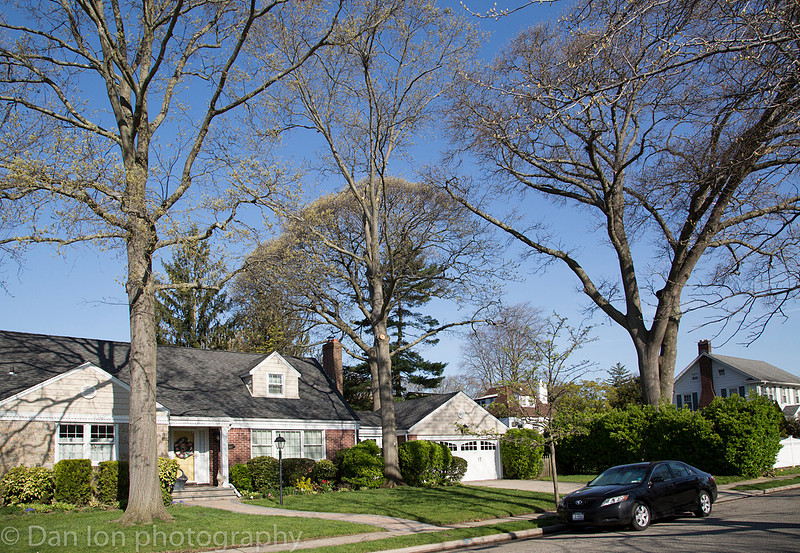
The house on this quite street has a good number of big trees in the front and back yard. This spring two of their trees have been taken over by nesting Yellow-crowned Night Herons. I counted five active nests and have seen at times more than 12 YCNHs in the trees as other herons are looking to find a nesting spot also. Yellow-crowned Night Herons are beautiful birds. Fairly big with very pretty plumage. So where is the conflict you may ask. The herons are ruining the everyday life of the people in that house. Poop! Yes, there’s poop everywhere. On the street, on the sidewalk, on their cars, on the house, on the patio table, in the
Yellow-crowned Night Herons produce a single brood and usually lay three to five pale blue-green eggs. After hatching, the chicks grow quickly for five weeks and fledge in about their sixth to eighth week. Even after fledging, the juveniles often remain attached to the nest for a couple more weeks. The complete breeding season can end as late as July or early August, when the juveniles have grown and learned enough to survive on their own.
The YCNHs are not a threat to humans. They could bite (not really) and they will take flight if people come too close to their area. However there is a remote potential threat of disease transmission. YCNHs are an intermediate host and amplifier of the eastern equine encephalomyelitis (EEE) virus, or sleeping sickness. The birds first get the virus from mosquitoes. Then the YCNHs can transmitted it to a wider range of mosquito species that then in turn transmit the virus to horses and humans.
The homeowners have spent a large sum of money to purchase their house. They are spending a lot more money on taxes, maintenance and gardening expenses, to support a lifestyle they like. The Yellow-crowned Night Herons have been around for thousands of years and have always found nesting places in trees close to water. They don’t know anything about property values and high taxes or suburban lifestyles. There’s no winner her. I feel for the homeowner and I also feel for the herons. Don’t know what I would do if this would happen to me. Setting up plastic tarps over the driveway and patio? Trimming
I don’t know what’s going to happen from now till the end of summer but I don’t have a good feeling about this situation. I feel bad for both sides. Link to YCNH gallery here Note: Click on the images to view at full size.
BIF photography ... and the B is for Bees
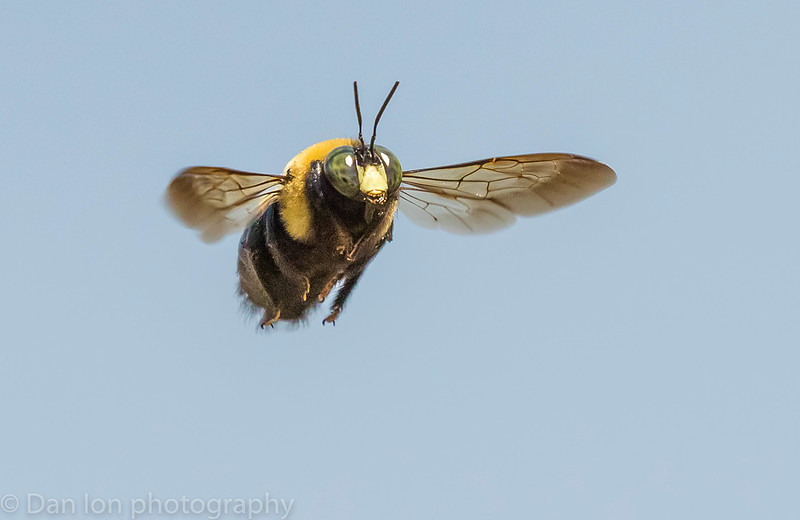
But there is another BIF that is even tougher to handle. Bees In Flight. Or small insects. They also fly around very fast but what makes photographing them in flight almost impossible is the extremely unpredictable flight path combined with the very very small size. Any insect smaller than a bee is going to be almost impossible to capture in flight. I gave this BIF a try recently and with some luck and some planning I got a few acceptable images.
The other option is to get a bee, or insect, as it approaches a flower. Since you are not hunting for it but are just waiting for the bee to come to the flower you know your focusing distance. Go to manual focus, focus on the flower, select a decent depth of field setting and as the insect approaches shoot away in burst mode. You’re bound to get a few sharp images. Good luck! Click on the image to see at full size. More images of the Carpenter bee gallery here. |